
I have developed a new hobby, which is unfortunate because I already possess enough interests that make me sound like someone’s eccentric aunt. I have started listening to old-time radio soap operas. Not sampling them while washing dishes. I mean downloading episodes, researching cast changes, and developing opinions about fictional people whose problems originally aired between advertisements for laxatives and fortified breakfast cereal. I have, somehow, become emotionally invested in daytime radio from an era when television was still considered something futuristic.
I decided to begin with This Is Nora Drake, mainly because Nora is a nurse. As a nurse myself, I assumed this would give me an easy point of entry. Perhaps I would encounter some quaint medical inaccuracies, a few dramatic bedside confessions, and a physician ordering Nora to fetch him something that no modern hospital has stocked since my grandparents were toddlers.
Instead, I found myself absorbed.
To be clear, I am no stranger to soap operas. I dabbled in Days of Our Lives during the 1990s, back when Marlena Evans was being possessed by the devil and nobody in Salem considered relocating. I watched Sunset Beach, a program that treated cursed jewels, evil twins, and spontaneous amnesia as normal coastal hazards. And Passions, which featured witches, talking dolls, and a town where seemingly every adult had suffered at least one supernatural pregnancy complication. I even made a brief foray into Port Charles, although apparently not enough people joined me, because ABC killed it after a few years.
But, radio soap operas are a different beast.
There are no elaborate mansions to admire, no meaningful glances held through a commercial break, and no actor slowly turning toward the camera after discovering that his dead wife is alive, evil, and now wearing bangs. Everything must be communicated through voices, footsteps, slamming doors, and swelling music that announces somebody has made a terrible decision.
And Nora Drake makes plenty of them.
The show follows the personal and professional life of a nurse who appears to spend approximately fifteen percent of her time nursing and the remaining eighty-five percent becoming entangled in the emotional disasters of everyone within speaking distance. Patients confide in her. Doctors rely on her. Men fall in love with her. Women misunderstand her intentions. Nora approaches each crisis with tremendous compassion and the vocal exhaustion of someone who has been charting since 1947.
Naturally, I can relate.
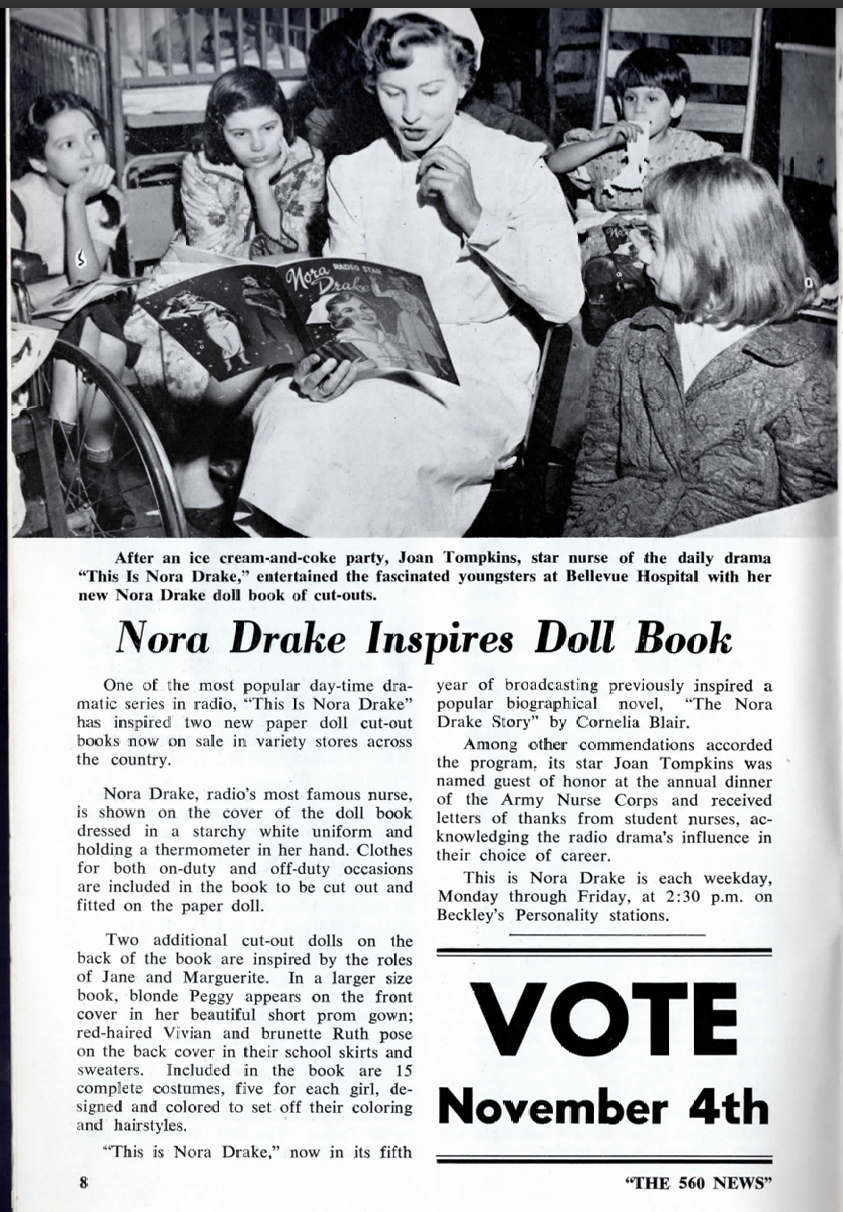
The promotional material only makes the entire phenomenon stranger. In one magazine clipping, Nora’s actress visits children at Bellevue Hospital following an ice cream-and-coke party and reads to them from a Nora Drake paper-doll book. The paper doll comes dressed in a starchy white uniform, holding a thermometer, with additional clothing for both on-duty and off-duty occasions.
This suggests that somewhere in postwar America, children were sitting on the floor deciding whether Nora should wear her nursing uniform or a smart evening ensemble before being summoned to handle another complicated romantic emergency.
The book also included fifteen complete outfits divided among three women, along with hairstyles that could be signed, colored, and cut out. At last, young girls could recreate the full excitement of professional nursing: wardrobe changes, emotional labor, and maintaining flawless hair while being blamed for something a doctor did.
The clipping proudly notes that This Is Nora Drake inspired not only paper dolls but also a biographical novel called The Nora Drake Story. Nora was apparently less a fictional character than a complete lifestyle brand. Today she would have a podcast, a line of compression socks, and a sponsored Instagram post explaining how she maintains work-life balance despite having none.
Listening to the show now is like opening a time capsule filled with melodrama, social expectations, and women saying things such as, I’m afraid there’s something I haven’t told you. The pacing is slower than a modern soap, but the emotional stakes remain wonderfully excessive. A perfectly ordinary conversation can acquire the gravity of an international incident. Someone pauses for half a second too long and the orchestra immediately assumes adultery.
And I'm in love it.
There is something comforting about hearing stories constructed almost entirely from dialogue and implication. The episodes are brief. The conflicts are clear. Nobody is checking a patient portal, arguing with an insurance company, or waiting on hold for prior authorization. Nora simply walks into a room, hears one trembling sentence, and realizes that somebody’s marriage is about to collapse.
It is healthcare stripped down to its most essential element: overhearing drama that has nothing to do with you and becoming involved anyway.
I began This Is Nora Drake because it was about a nurse. I stayed because I needed to know whether Nora would ever stop carrying the emotional weight of the entire metropolitan area. Based on my experience with nursing and soap operas, I suspect the answer is no.
And so my bizarre new hobby continues. Somewhere between Days of Our Lives and Passions, I apparently developed the necessary antibodies to survive several hundred episodes of romantic anguish delivered through a tabletop radio.
This is Nora Drake. And, regrettably, this is who I am now.